
On July 9, 2026, OpenAI moved its GPT-5.6 family from limited preview into general availability, and with it came three named models that are quickly becoming part of everyday conversations among developers, researchers, and businesses: Sol, Terra, and Luna. Instead of shipping a single monolithic model, OpenAI now offers a tiered lineup where the number (5.6) identifies the generation, while the names describe durable capability tiers that can each advance on their own schedule. In this guide we break down what each model does, how they differ, what they cost, and how they compare to the previous GPT-5.5 generation as well as the newest models from Google (Gemini) and Anthropic (Claude).
What Is the GPT-5.6 Family?
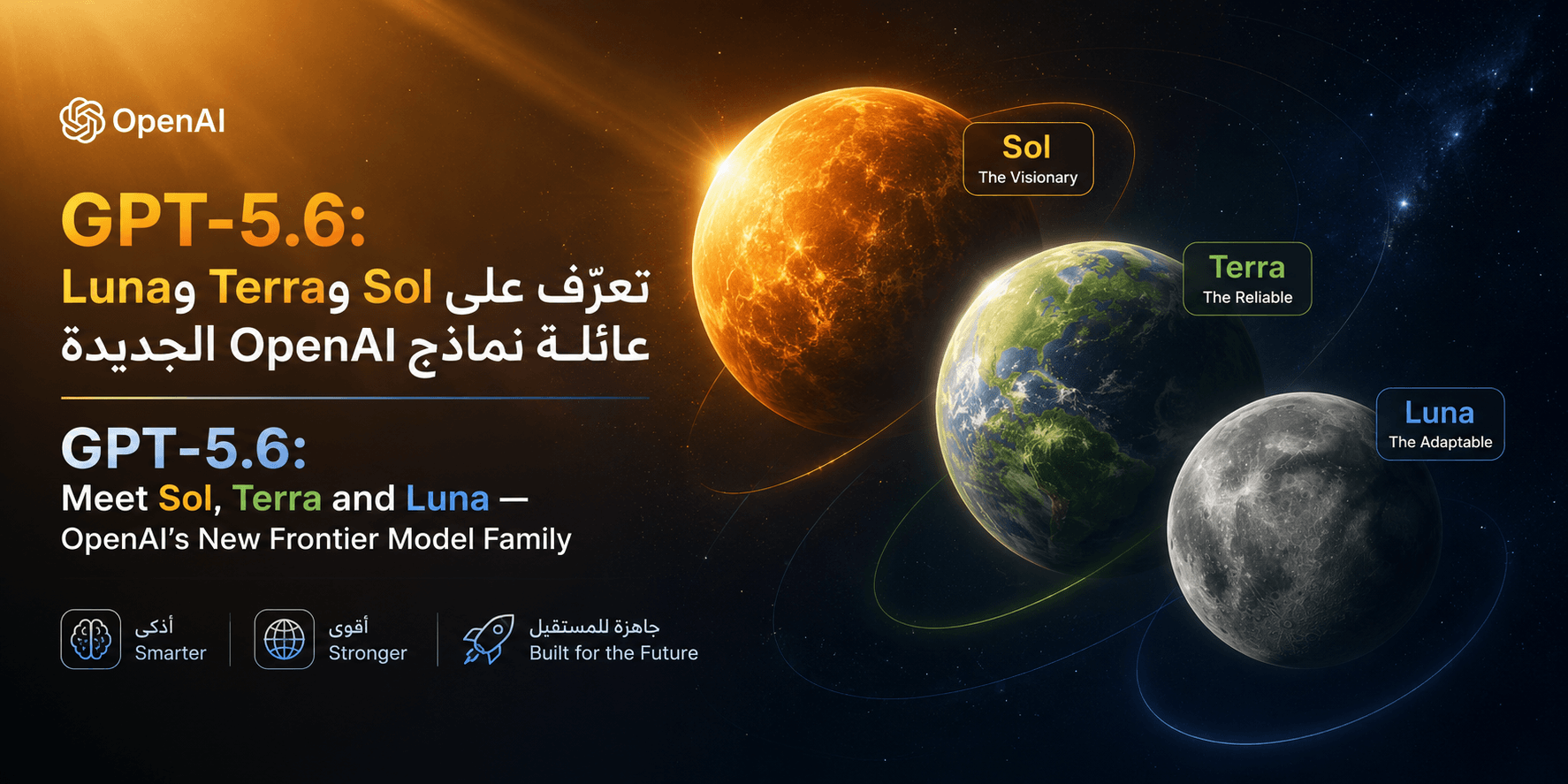
GPT-5.6 is the latest generation of OpenAI’s flagship large language models. What makes this release different from earlier launches is the naming strategy. Rather than forcing every user onto one model, OpenAI split the generation into three tiers designed for different needs and budgets. Sol is the top-tier flagship, Terra sits in the middle as a balanced everyday workhorse, and Luna is the fast, affordable option. Because these names represent durable tiers, future generations can improve each one independently, giving users a clearer mental model of what they are choosing. You can read the full announcement on the official OpenAI GPT-5.6 page.
Meet Sol: The Flagship
Sol is the crown jewel of the family. OpenAI positions it as setting a new standard for both intelligence and efficiency, delivering strong results across coding, knowledge work, cybersecurity, and science while using fewer tokens than previous and competing frontier models. In practical terms, that means more successful work for the same spend, or comparable results at a lower total cost. Sol also introduces higher-effort settings for the most demanding tasks. A “max” mode gives the model additional time to reason, explore alternatives, and revise its approach, while an “ultra” mode coordinates multiple agents working in parallel to finish complex tasks faster. Sol is also available in a “Sol Pro” variant aimed at the highest-quality results on especially complex problems.
Sol’s strengths show up clearly in independent evaluations. It reaches state-of-the-art scores on coding-agent benchmarks and long-horizon professional tasks, and it demonstrates notably stronger design judgment, producing tasteful, functional interfaces from only high-level direction. Improved computer-use abilities let Sol inspect and refine the rendered result, not just generate underlying code, so it can catch visual and functional issues before handing work back.
Meet Terra: The Balanced Everyday Model
Terra occupies the middle tier, offering performance competitive with the previous generation at a meaningfully lower cost. It is the model most people will encounter for everyday work. Free and lower-tier users of ChatGPT Work and Codex get access to Terra, and it handles the bulk of common tasks such as drafting documents, summarizing information, writing code, and answering questions with speed and reliability. Terra is designed to make capable AI more affordable without sacrificing the quality that professional workflows demand, and in several benchmarks it surpasses the prior flagship at a fraction of the cost.
Meet Luna: The Fast and Affordable Option
Luna is OpenAI’s fastest and most cost-efficient model in the GPT-5.6 lineup. It is built for high-volume, latency-sensitive, and budget-conscious use cases where speed and price matter most. Despite its lower cost, Luna is far from a lightweight: OpenAI notes that it nearly matches the previous generation’s peak performance at less than half the estimated cost, and outperforms strong competing models on several coding evaluations while running in a fraction of the time. For developers building applications that make many AI calls, Luna makes it economical to embed intelligence at scale.
GPT-5.6 vs GPT-5.5: What Changed?
The table below compares the three new GPT-5.6 tiers against the previous flagship, GPT-5.5, using OpenAI’s officially published benchmark figures. Higher numbers are better.
| Benchmark | GPT-5.6 Sol | GPT-5.6 Terra | GPT-5.6 Luna | GPT-5.5 (previous) |
|---|---|---|---|---|
| Artificial Analysis Intelligence Index | 58.9 | 55.0 | 51.2 | 54.8 |
| Coding Agent Index | 80.0 | 77.4 | 74.6 | 76.4 |
| Agents’ Last Exam (%) | 52.7 | 50.4 | 50.3 | 46.9 |
| SWE-Bench Pro (%) | 64.6 | 63.4 | 62.7 | 59.4 |
| GPQA Diamond (%) | 94.6 | 92.9 | 92.3 | 93.6 |
| BrowseComp (%) | 90.4 | 87.5 | 83.3 | 84.4 |
| Input price (per 1M tokens) | $5.00 | $2.50 | $1.00 | — |
| Output price (per 1M tokens) | $30.00 | $15.00 | $6.00 | — |
The headline takeaway is efficiency: Sol pushes ahead of GPT-5.5 across coding, agentic, and knowledge-work benchmarks while using fewer tokens, and even the smaller Terra and Luna tiers match or beat the previous flagship on many tasks at a small fraction of the cost.
GPT-5.6 vs Google Gemini vs Anthropic Claude
How does OpenAI’s new flagship stack up against the newest models from its main rivals? The table below places GPT-5.6 Sol next to Google’s Gemini 3.1 Pro and Anthropic’s Claude models (Fable 5 and Opus 4.8), using the comparison figures OpenAI published alongside the launch. As always, benchmark leadership shifts frequently, so treat these as a snapshot from July 2026.
| Benchmark | GPT-5.6 Sol | Gemini 3.1 Pro | Claude Fable 5 | Claude Opus 4.8 |
|---|---|---|---|---|
| Artificial Analysis Intelligence Index | 58.9 | 46.5 | 59.9 | 55.7 |
| Coding Agent Index | 80.0 | 42.7 | 77.2 | 72.5 |
| Agents’ Last Exam (%) | 52.7 | 32.1 | 40.5 | 45.2 |
| SWE-Bench Pro (%) | 64.6 | 54.2 | 80.0 | 69.2 |
| GPQA Diamond (%) | 94.6 | 94.3 | 92.6 | 92.0 |
| BrowseComp (%) | 90.4 | 85.9 | 84.4 | 84.3 |
The picture is nuanced. GPT-5.6 Sol leads on agentic tasks, coding-agent workflows, and browsing, and it runs neck-and-neck with Gemini 3.1 Pro on the academic GPQA Diamond test. Anthropic’s Claude Fable 5 edges ahead on the broad intelligence index and on the SWE-Bench Pro software-engineering benchmark, showing that the frontier remains highly competitive and that the “best” model still depends on your specific task.
Efficiency, Tool Use, and Multi-Agent Work
A recurring theme across GPT-5.6 is getting more useful work from every token. The models can write and run lightweight programs that coordinate tools, process intermediate results, monitor progress, and choose the next action as work unfolds. This “Programmatic Tool Calling” in the Responses API lets tool-heavy tasks advance with fewer round trips and less manual scripting. For the most demanding jobs, the multi-agent capability lets the model run concurrent sub-agents and synthesize their work in a single request. Together these features push AI beyond simple question-and-answer into genuine end-to-end task completion.
Safety and Security
OpenAI describes GPT-5.6 as launching with its most robust safeguards to date. Before general availability, the models went through an extensive evaluation period combining human red teaming with large-scale automated testing. The safety system is layered, pairing protections trained into the model with real-time checks, continuous monitoring, and account-level enforcement so the system stays resilient even if one layer fails. OpenAI states the models are more capable in biology and cybersecurity than earlier versions but do not cross its “Critical” risk threshold in either category. Full details are available in the GPT-5.6 system card and announcement.
Availability and Pricing
GPT-5.6 is available across ChatGPT, Codex, and the OpenAI API, with a gradual global rollout. Plus, Pro, Business, and Enterprise users can access Sol, while free and Go users get Terra, and paying users can choose among all three tiers and set an effort level for each. API pricing is quoted per one million tokens: Sol costs $5 for input and $30 for output; Terra is $2.50 input and $15 output; and Luna is $1 input and $6 output. Developers can learn more and start building through the OpenAI API documentation, and general users can try the models at ChatGPT.
Frequently Asked Questions (FAQ)
What are Sol, Terra, and Luna in GPT-5.6?
They are the three tiers of OpenAI’s GPT-5.6 generation. Sol is the flagship for the hardest tasks, Terra is a balanced everyday model, and Luna is the fastest and most affordable option. The number 5.6 marks the generation, while the names are durable tiers that can each improve over time.
How much does GPT-5.6 cost?
Per one million tokens, Sol is $5 input / $30 output, Terra is $2.50 / $15, and Luna is $1 / $6. ChatGPT subscribers also get access to different tiers depending on their plan.
Is GPT-5.6 better than Gemini and Claude?
It depends on the task. GPT-5.6 Sol leads on agentic, coding-agent, and browsing benchmarks, while Anthropic’s Claude models lead on some software-engineering and broad-intelligence tests. Google’s Gemini 3.1 Pro remains competitive on academic reasoning. The frontier is close, so the best choice varies by use case.
Where can I use GPT-5.6?
You can access it through ChatGPT, Codex, and the OpenAI API. The tier available to you depends on your subscription plan, and developers can select Sol, Terra, or Luna directly via the API.
What does “ultra” mode do?
Ultra is Sol’s highest-capability setting. It coordinates multiple agents working in parallel to tackle complex tasks faster, trading higher token usage for stronger results and quicker time-to-result on demanding work.
Related Articles from StapX
- The Best Way to Generate AI Images 2026
- The Complete Guide to AI SEO (GEO): How to Rank in the Age of AI Search
- Web Development and Design in Saudi Arabia: A Complete 2026 Guide
Sources and References
- OpenAI — GPT-5.6: Frontier intelligence that scales with your ambition (official announcement & benchmarks)
- OpenAI News (official)
- OpenAI API — Models documentation and pricing
- ChatGPT (official product)
All benchmark figures and pricing in this article are drawn from OpenAI’s official GPT-5.6 announcement, published July 9, 2026. Because AI models evolve rapidly, always consult the official sources above for the most current information.